(Updated February 12, 2024) NMWD began its annual water main flushing program recently. This is a standard practice to ensure there is no degradation in water quality and to maintain an adequate chlorine residual (disinfectant) which helps prevent any bacterial growth in the pipelines. Customers may temporarily experience low water pressure or a slight, but harmless color in their water when the flushing is conducted in their neighborhood. This is an annual practice that has been put on hold for the last couple years due to the drought. NMWD crews have developed specific routes and use of isolation valves to maximize results using the least amount of water possible. Flushing is performed in the winter months when there is sufficient water supply for the task.

(Updated February 12, 2024) NMWD began its annual water main flushing program recently. This is a standard practice to ensure there is no degradation in water quality and to maintain an adequate chlorine residual (disinfectant) which helps prevent any bacterial growth in the pipelines. Customers may temporarily experience low water pressure or a slight, but harmless color in their water when the flushing is conducted in their neighborhood. This is an annual practice that has been put on hold for the last couple years due to the drought. NMWD crews have developed specific routes and use of isolation valves to maximize results using the least amount of water possible. Flushing is performed in the winter months when there is sufficient water supply for the task.
(Posted February 8, 2024) Stafford Lake is now full and water started to spill over Stafford Dam as of Sunday February 4, 2024. Recognizing this event, we wanted to inform you of some of the rigorous Stafford Dam safety measures we implement.
The North Marin Water District (NMWD) manages the potential risks associated with Stafford Dam through a robust dam safety program that includes visual observations (including use of 24-hour surveillance cameras); measuring and analyzing groundwater water levels and controlled seepage; semi-annual vegetation and rodent control; annual engineering inspections of the dam including all appurtenances; and annual inspection by the state’s Division of Safety of Dams (DSOD) engineers.
In addition to regular periodic inspection, NMWD performs special engineering inspections using its in-house professional engineers, as well as detailed engineering analysis by outside specialists for various purposes. Every 5-years, NMWD’s performs a physical survey of dam crest to monitor settlement and movement and have done this since the dam was raised in 1985.
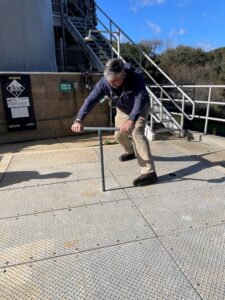
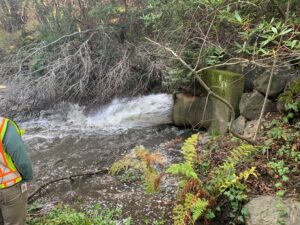
On January 30, 2024, a DSOD engineer performed the annual inspection of Stafford Dam, including the spillway, outlet pipe and seepage collection system in accordance with the DSOD Inspection Protocols. As part of that inspection, NMWD Operators demonstrated the ability to quickly release water from behind the dam (Stafford Lake) via the 30-inch diameter outlet pipeline.
Check out this video of the water discharging from the valve.
(Posted January 25, 2024) As part of an ongoing commitment to being better prepared to respond to extreme weather events, North Marin Water District (NMWD) has joined the Center for Western Weather and Water Extremes (CW3E) Water Affiliates Group, in partnership with Marin Municipal Water District (MMWD) and the County of Marin.
This multi-agency group leverages the work of the CW3E at UC San Diego’s Scripps Institution of Oceanography to advance understanding of atmospheric rivers, strategically improve water management, mitigate flood risk, and increase water supply reliability.
Atmospheric rivers are defined by the National Oceanic and Atmospheric Administration (NOAA) as “relatively long, narrow regions in the atmosphere – like rivers in the sky – that transport most of the water vapor outside of the tropics.” As reported by CW3E, extreme rainfall caused by these columns of condensed water is responsible for nearly 85% of flooding events along the West Coast.
NWMD joining the CW3E Water Affiliates Group also reflects NMWD’s response to the recommendations of the Dam and Reservoir Safety report issued in June 2023 by the Marin County Civil Grand Jury. As the report reflects, NMWD’s Stafford Dam is in full compliance with the California Division of Safety of Dams (DSOD) regulations regarding dam safety and operations. However, per the Report, “regulatory agencies requirements for dam safety do not incorporate the latest scientific information on climate change.”
As such, the Report recommended that NMWD (and MMWD) should “begin collaboration with scientific institutions” to expand our toolkit of mitigation strategies in light of the growing risk presented by atmospheric river events. Joining the CW3E Water Affiliates Group is a significant step in connecting with like-minded organizations and understanding atmospheric rivers and implementing real-world water resource solutions through decision support tools developed by CW3E.
(Posted January 5, 2024) Customers are welcome and encouraged to attend North Marin Water District’s Special Board Meeting on January 9, 2024 at 4pm. For more details, click here.
(Posted December 21, 2023) On December 19, 2023, the District revised Regulation 18 (Recycled Water Service), and enacted a new Regulation 19 (Enforcement for Recycled Water Use).
District Regulation 18 describes the availability of recycled water as well as the requirements and procedures, including formal agreements and permits necessary for connection to, extensions of, or modifications to, the District’s Recycled Water distribution system. These regulations generally apply to new development but can be applicable to a commercial property owner requesting new recycled water service for certain approved uses and where the District has determined a retrofit of the existing water service facilities is feasible to accommodate recycled water service. The revised Regulation 18 clarifies the intent and purpose of the regulation and provides a new section on the definition of terms used. The revised Regulation 18 also provides more clarity on exemption requests and determinations by the District for mandatory use exemptions as well as a new section on protection of public health. To view the updated version of Regulation 18, click here.
The new District Regulation 19, serves as a stand-alone enforcement regulation for recycled water use. The new Regulation 19 includes sections addressing violations, public nuisance related to unauthorized discharges, the liability associated with violations, non-compliance, and associated District recourses, and mandatory use assurance section. Importantly, the proposed Regulation 19 cross-references existing District Regulations 1, 6, 18, and 55, that address the handling of costs incurred by the District to correct the condition of illegal or non-permitted use as well as termination of service for non-compliance (Regulation 55). To view the new Regulation 19 click here.